
Serge BJJ · One-on-one sessions
Your athletic success, engineered.
Systematic one-on-one coaching from a competition black belt with 20 years on the mats, a PhD from UNC Chapel Hill, and a Wall Street day job. Most coaching shows you moves. This builds YOU with a holistic, systematic approach, so you can progress multiple times faster.
Live on video. By application. Every applicant is reviewed personally.
Why I built this
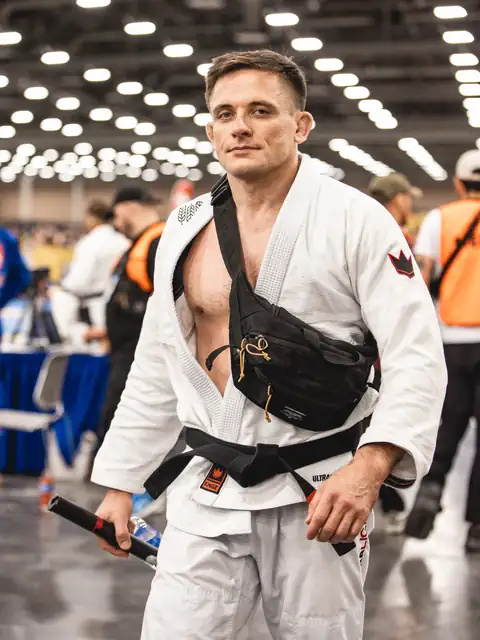
I’ve been on the mats for 20 years. Those years have taught me far more than technique. They taught me how progress actually happens: how to improve a process, a technique, a body, a mindset, and how to learn faster this year than I did the last. The biggest lesson is that being intentional about your practice, about your training and about everything you do between sessions, lets you progress multiple times faster than the average practitioner.
Jiu jitsu allowed me to develop a lot of valuable life skills. On the mats, I developed a work ethic, perseverance, and the ability to think and function under pressure. These qualities, forged on the mats, were instrumental in earning my PhD at UNC Chapel Hill, one of the top political science programs in the nation. I also earned my BJJ black belt around the same time I completed my PhD.
That is when it came full circle. As a newly promoted black belt, I started studying Jiu Jitsu on a more serious, deeper level, and I took everything the PhD had taught me about analysis and learning and applied it back to the mats. I further sharpened those skills as an Ivy League visiting professor at Dartmouth and later in my day job on Wall Street. Very different settings, but the same skill: systematic analysis. Identifying the important drivers of results and separating them from the noise.
It took me a while to figure out how to level up on things that make a difference: technique, strategy, understanding of grappling, nutrition, supplements, athleticism, strength, endurance, mindset, positive thinking, visualization, and faith. I slowly leveled up on each of those (and continue to do so) and results followed: IBJJF medals as a black belt in both the Adult and Masters 1 divisions, around a full-time job, and a podium at the 2025 Brasileiro No-Gi.
I believe success in Jiu Jitsu and in life can be engineered. Over 20 years on the mats, I’ve explored the different areas that make a difference. Now I help others optimize those areas, so they can reach their goals faster and unlock their potential.
Major competition accomplishments
- 3rd place, IBJJF Brazilian Nationals No-Gi (Brasileiro), 2025 (Masters 1, black belt, middleweight division)
- 2nd place, IBJJF Fort Lauderdale International Open, 2026 (Adult, black belt, middleweight division)
- 2nd place, IBJJF Virginia International Open, 2025 (Masters 1, black belt, middleweight division)
- 2nd place, IBJJF New Jersey Spring International Open, 2025 (Masters 1, black belt, middleweight division)
- 2nd place, IBJJF New York Summer International Open, 2024 (Masters 1, black belt, middleweight division)
Adult is the open-age professional division; Masters 1 is 30 and over. Brasileiro is one of the four IBJJF Grand Slam events, alongside Worlds, Europeans and Pans.
Here’s the problem
Technique matters enormously, but it is only one piece of a much bigger puzzle. Jiu jitsu is a lot more than a set of techniques. But look at what most people train, and where almost all of the emphasis goes: learning techniques, drilling techniques, learning another new guard.
Look at what actually contributes to elite performance in any sport, and the list is much longer:
- Technical skill. The techniques themselves, and the details that make them work consistently against good, athletic opponents
- Understanding of grappling. How grappling actually works. A deeper understanding of the principles allows for creativity and fluent improvisation in the moment
- Tactical understanding. Knowing when to use what: reading your opponent, the score and the clock, and adjusting your game plan in the moment
- Development strategy. Identifying where to invest and what to work on, so you build a complete game that works
- Strength and conditioning. Strength is a skill you build like any other. Endurance is your gas tank, and without it everyone looks silly
- Movement and mobility. Your ability to control your body through increasingly complex movement makes a huge difference in your athletic performance. The cerebellum is the part of the brain that coordinates movement. Brain scans show that in athletes who have trained complex movement for years, key parts of it are larger than in non-athletes. And movement isn’t only about athletic performance; it shapes the quality of your everyday life. Everything that is alive is characterized by movement
- Nutrition and supplements. If you want great outputs, you need great inputs. Give your body the building blocks for muscle, fascia and athleticism, prevent injuries, and keep going for the long term. Modern food often doesn’t carry the vitamins and minerals it used to, and athletes need more than non-athletes: sweat isn’t just water, and what you lose has to be replenished
- Sleep and recovery. Recovery is a science of its own: the better you recover, the more you can train, and the more you train, the further ahead you get. Sleep is a necessity, and deep sleep is also a skill. If you are not getting good, deep sleep consistently, it usually points to issues that need to be addressed
- Mindset and mental resilience. Confidence, focus, composure under pressure and resilience all shape your performance. Mindfulness helps you progress much faster and brings your gifts to the surface. These mental attributes need consistent practice, not just on competition day
- Visualization and faith. If you can see it, you can achieve it. As the saying goes, whether you think you can or you think you can’t, you’re right. You have to see it, and you have to believe you can achieve it. Your ability to visualize and to believe will both grow from level to level through consistent, deliberate practice
- Positive thinking. We all start in very different places on this one. For me, it was a foreign language I had to learn. I’m very glad I put in the work to become fluent, because it makes a huge difference in competition, and an even bigger one in the rest of your life
People are different, so what to prioritize first to get the best results is different for every person. We start by identifying what is currently holding you back. We go after the low-hanging fruit that is slowing you down now, and at the same time we invest in your long-term performance.
Importantly, the goal doesn’t have to be competition. Medals can be tremendously important to an athlete, and that’s fine. But this is far too much work just for medals. The real reward is who you become. On the way to those championships, you grow into a more resilient, tougher, healthier, more aware and more awake human being: a version of you that is closer to your potential.
Here’s the good news
Small, incremental improvements across these areas compound into a huge difference, on the mats and off them. This looks like a lot, but you don’t need to overhaul everything at once. A little better in each area, consistently, adds up faster than most people believe. And off the mats is where the real gain is: the same habits make you better at your work, your health, and everything else you set out to achieve.
What if…
… you could pinpoint exactly what is holding back your progress right now, and which areas would make the biggest difference in the shortest time?
… you had a long-term development strategy built around your body, your personality, your schedule and your ruleset, instead of borrowed from whoever posted the last instructional?
… you stepped onto the mat with a mind that works for you: a plan you trust, composure under pressure, and the freedom to improvise?
… your three or four sessions a week produced more progress than other people’s six, because every hour had a job, and your body was still fresh for the next decade?
All of that is possible without quitting your job, buying another instructional, or grinding yourself into injury. It takes the right approach.
Six focus areas. You pick.
Every session is built around one of these six areas, or spread across all of them. When you book, you choose the overall focus; we can touch on everything in one hour or dedicate the entire session to a single area. Bring your questions on each area you want covered. The more specific they are, the more we get done.
Focus 01
Systematic Game Development
We look at what you do well, where you are weak, and where to invest your development time based on your body type, your personality, and what you like and don’t like to do. Then we fit it all together into a game that maximizes your gains for the time you put in.
Focus 02
Technique Refinement
The small details are what separate good athletes from great ones. A technique either works on good black belts or it doesn’t, and the difference is almost always a grip, an angle, a weight shift or a moment of timing. We find those details and make the technique yours.
Focus 03
Game Day Strategy
You need a game plan, and you need to stay flexible when it breaks. We identify the scenarios you are most likely to end up in on the day and build a strategy for each one, around the ruleset, the bracket and the opponent in front of you, so you step on the mat knowing what you are going to do.
Focus 04
Mindset & Mental Performance
For competition day and every day in between. Mindfulness and intentional presence let you learn and progress much faster than the average competitor, and addressing the mental blockers, the hesitation, the doubt, the fear of losing, unlocks potential that training alone never reaches. Whether you freeze in big matches, give good opponents too much respect, or roll like a champion in the gym and tighten up in the bracket, we train it the way you train strength: specific exercises, practised and tracked. Perform freely instead of carefully. This is coaching, not therapy.
Focus 05
Athleticism, Strength & Conditioning
Athleticism is not about looking like a bodybuilder. It is the ability to move, react and keep going: reaction time, endurance, and the strength to function in every position jiu jitsu puts you in. We condition your body to perform in all of them, which is also how injuries get minimized.
Focus 06
Nutrition & Supplements
Few things have a bigger impact on how long you get to do this. The more longevity matters to you, the more this matters. Eating that fuels hard training, makes weight without wrecking it, speeds recovery and minimizes injury, plus which supplements actually earn their place.
Here’s exactly what you get
Everything starts with the assessment. Pick your focus areas when you apply. Every session ends with something in writing; the thinking is the product.
Start here
Assessment Session
60 minutes · video call
By application
- Pre-session questionnaire, your questions on each focus area, and a few minutes of your rolling or competition footage reviewed before we speak
- Your choice of focus: one of the six areas in depth, or a full assessment across all six
- A written one-page plan within 48 hours: where you stand in each area, where to invest first, and the three things to work on for the next 30 days
- One follow-up email for questions
Build
90-Day Development Block
Three 60-minute sessions over 90 days
By application
- Three full sessions, each with its own focus area, building on your assessment
- Written plan updated after each session
- Game day strategy and mental preparation built around a specific event, if you have one
- Priority scheduling and email access between sessions
Mindset program
Athlete Mindset Program
Four 45-minute sessions over six weeks
By application
- Starts from your assessment: exactly which mental skills are holding you back
- A personal mindset plan: pre-match routine, pressure protocol, and between-round reset
- Mental exercises and worksheets you practise between sessions and track
- Built around a specific competition date if you have one
Returning clients only
Focused Mini Session
30 minutes · video call
By application
- One focus area, one problem: a single position, technique, game plan or pre-competition check-in
- Available after an Assessment Session
- Updated notes added to your existing plan
Is this right for you?
The competitor who wants to medal
You compete a few times a year and you want to win the big ones. You need a plan for the ruleset, the bracket, your body and your head, not another instructional.
The person using jiu jitsu to build themselves
You may or may not compete. For you, jiu jitsu is a tool for developing the whole person: discipline, composure, the ability to overcome fear and keep improving. You want those lessons to carry into the rest of your life, and you want to get them faster.
The one who measures success in decades
Medals are nice, but success for you is still training, healthy and strong, twenty years from now. You want to do this the natural way: wellness, longevity and a body that holds up, with performance as the by-product.
The person who wants the investment to pay off
You put serious hours, money and energy into this. You want that investment to pay off: every session moving you forward instead of just wearing you out. Efficiency matters to you, on the mats and everywhere else, and you’d rather have a plan than hope.
Why this is different
Learn from an active competitor
I compete as a black belt in the Adult and Masters 1 divisions and represent Marcelo Garcia Jiu-Jitsu NYC. In 2025 I took 3rd at the Brasileiro No-Gi. What I teach works in today’s competitive environment. You won’t find me coaching from the sidelines. I’ll be there with my sleeves rolled up, in the trenches.
Optimize your body, mind and techniques
I offer a holistic approach. We look at everything that drives your performance and build a plan to improve each part, so you progress on every front, not just one.
Find what’s holding you back
I believe many of our limitations are placed on us by our environment, by society, by others, or even by ourselves. I will help you identify those limitations so you can break through them. Beyond those limitations, we will also identify some quick wins and build a plan for your long-term development.
Let small gains compound
Becoming a better jiu jitsu athlete takes a lot of work. We identify what matters most for you and build a plan you can follow one step at a time. Some changes take a while, like significantly improving your decision-making speed or your movement ability. But six months from now, you will either be a better athlete or you won’t. The choice is yours.
Maximize the return on your training sessions
I compete at the black belt level while holding a demanding full-time finance job, so I’ve learned to be intentional with my time on the mats, in the gym, and while studying jiu jitsu. I don’t walk into class without learning something. I don’t show up to practice just to go through the motions. I’ll teach you how to do the same.
Unlock your creativity
I won’t just teach you what to do. I will help you understand why and how it works. A deeper understanding of jiu jitsu allows you to improvise in the moment and be more expressive, efficient and creative on the mats.
Make your jiu jitsu count off the mats
You put years into mastering the most technical fighting system ever created. The carryover isn’t automatic. But with intention, the principles you learn on the mats can improve your life off them.
Get one-on-one attention
This is not a mass product. I enjoy working with people individually, so I keep my client list small and every person gets real attention. By application.
Common questions
Do you work with beginners?
Yes. The earlier you build the right habits, in how you train, recover, eat and think, the more years of wasted effort you skip. We start with the areas that will make the biggest difference for you right now.
Is it only for competitors?
No. Most clients train for themselves and want to get better faster with less wasted effort. If you compete, we build the plan around your events; if you don’t, we build it around your training. Either way, the bigger reward is who you become along the way.
What should I prepare?
Your questions. Pick the focus areas you want covered and write down what you actually want answered in each: the position you keep losing, the game plan you’re unsure of, the diet or lifting question you’ve never had a straight answer to. Specific questions get specific answers.
Do I need to send footage?
A few minutes of rolling or competition footage before the session is welcome. It lets me see your game before we meet, so more of the hour goes to answers. If you have none, we work from your questionnaire.
How are sessions held?
Live on video. In-person sessions in New York City are available by arrangement.
What does it cost?
The assessment is a paid one-hour session, and pricing for everything after it is premium and depends on the format. I share it when you apply, so you know exactly what you are getting before you decide.
Does the assessment commit me to anything?
No. The assessment stands on its own and you leave with a written plan either way. If we both think more work makes sense, we talk about it then.
What happens after I apply?
I reply to every request within two business days. If it’s a fit, you get a booking link and a short pre-session questionnaire, and we build your plan from there.
Serge BJJ
Ready to engineer your success?
Start with a one-hour assessment session. Tell me about your game, where it leaks, and what you want it to do. By application.
Every applicant is reviewed personally. Replies within two business days.